Trendex.VIP
Trendex.VIP is a play-to-earn web platform where users purchase shares linked to real-life celebrities, called Talents, who are under contract with Trendex. Users collect Talent cards and use them to enter weekly tournaments for real-money rewards, with rankings determined by the performance of the cards they select.
My role combined product management, game design and Scrum facilitation. I was involved across the full lifecycle of features, from early product discussions and game-system design to UI collaboration, development planning, testing and release.
Gamifying the platform
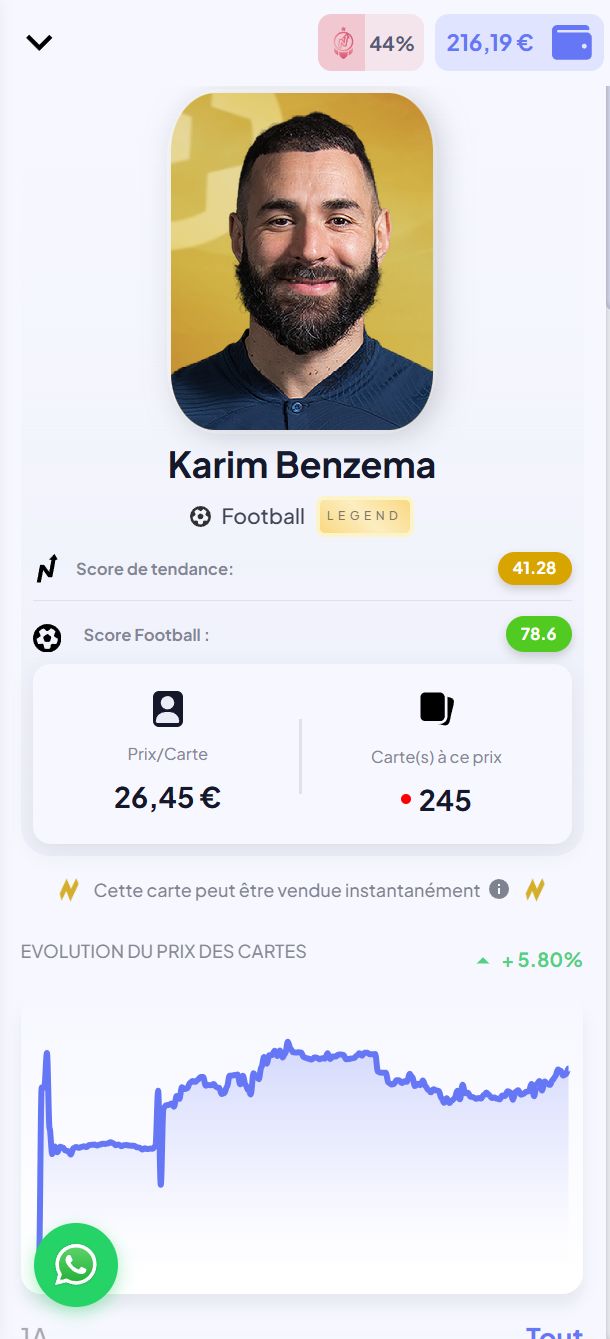
One of my main objectives was to strengthen the gaming dimension of the platform. I worked on tournament mechanics, progression systems and economic features designed to make competitions more strategic, dynamic and engaging.
The product later shifted towards onboarding professional football and basketball players, introducing sports tournaments structured like fantasy sports: a Talent's score was driven by the athlete's real-life performances during each tournament window.
I contributed to the design of these tournaments, including:
- Tournament rules and scoring systems
- Player selection and prediction mechanics
- Player match histories, score histories and performance breakdowns
- Tournament interfaces, designed in collaboration with the UI designer
This turned each tournament into a real-life prediction game, where users had to evaluate players, anticipate their performances and build the most competitive selection.
Play-to-earn economy design
Improving the play-to-earn economy was the most challenging part of my work, as it meant balancing player rewards, platform revenue and competitive fairness at the same time.
The most significant feature I designed was the Score Booster: during a tournament, users could purchase a temporary score increase to improve their ranking.
The system was built around a clear risk-reward calculation. A booster became attractive when the additional reward from reaching a higher rank exceeded its cost. But when one user improved their position, other players were overtaken and found themselves in the same situation, encouraging them to react and reconsider using a booster themselves.
This created a dynamic competitive loop that ran through the whole tournament, increasing tension and engagement while generating additional revenue for the platform. The main design challenge was keeping boosters understandable and strategically valuable without making the competition feel entirely dependent on spending.
Onboarding and user experience
I also improved the onboarding flow and the in-app tutorial. By gathering user feedback, analysing support requests and identifying recurring points of confusion, I simplified the first-time experience and clarified the platform's core concepts: Talent ownership, tournament participation, scoring and rewards. The goal was to reduce friction and help new users grasp the product's value and game loop more quickly.
Product and project management
As Product Manager and Scrum Master, I coordinated a distributed, multidisciplinary team: eight developers (four on site, four working from another time zone) and a remote QA tester. I ran the Scrum ceremonies, prepared and prioritised the backlog, planned sprints and coordinated development against product objectives.
Sprint planning meant constantly arbitrating between new features, game-economy improvements, known bugs, UI and UX work, support tickets and release requirements. Working across time zones also demanded clear documentation and structured communication between design, development, QA and product stakeholders.
I contributed to most of the features and game mechanics built during my time at Trendex, from identifying user and business needs to designing systems, defining interfaces, supporting implementation and preparing releases. The role let me combine game design thinking with product strategy and operational management, on a live platform involving real users, real-money rewards and a complex play-to-earn economy.